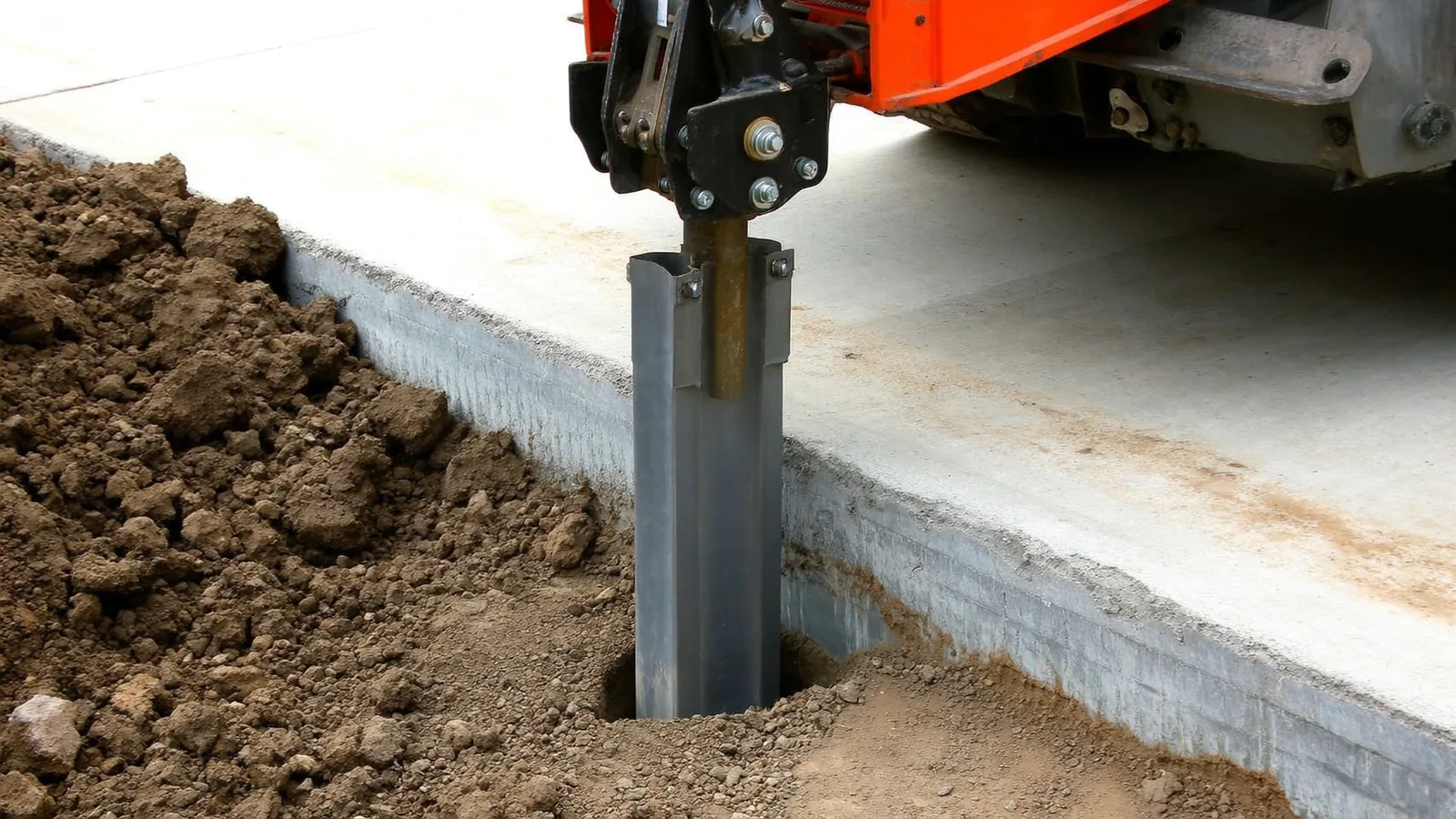
What are steel push piers and when are they the right choice?
Steel push piers are segmented steel cylinders, typically two to three inches in diameter, hydraulically driven through weak or unstable soil until they reach bedrock or a dense bearing stratum. Once a pier reaches refusal, confirmed by load testing, a bracket transfers the structure’s weight from the failing footing onto the pier. The installer then uses synchronized hydraulic jacks to lift the foundation back toward its original elevation and locks the system in place. The result is a foundation bearing directly on rock rather than on whatever fill, clay, or void-riddled soil caused the settlement in the first place.
In Knoxville and Knox County, this method is frequently the right call. The Great Appalachian Valley’s residual clay and silty clay soils carry moderate-to-high shrink-swell potential, and beneath that clay sits karst limestone with documented sinkhole and solution-cavity activity throughout the county (USDA Web Soil Survey, Knox County, Tennessee; Tennessee Geological Survey karst mapping). Bedrock contact is not just a performance goal, it is the only reliable bearing point when subsurface voids exist. For a deeper look at local soil conditions and how they affect your foundation, read the foundation problems affecting Knoxville homes and their causes.
How push piers work mechanically
Each pier starts as a bracket bolted to the existing footing. Sections of galvanized steel pipe are added one at a time as hydraulic pressure drives the assembly deeper. The driving force comes from the building’s own dead load, the weight of the structure pushes the pier down while the bracket holds position at the footing. When the pier encounters a layer that resists further penetration under that load, the crew performs a load test to confirm the bearing value meets or exceeds the design requirement. Sections typically run about three feet each, so a pier reaching 24 feet of depth uses roughly eight sections plus drive hardware.
The conditions push piers are designed for
Steel push piers are specified when soil movement is deep-seated rather than surface-level. The classic Knox County scenario is a home built on valley-position clay that has been cycling through 48-inch annual rainfall wet-dry seasons for decades (NWS Morristown KMRX, 1991-2020 Climate Normals), slowly losing bearing capacity as the clay softens and compresses. They are also the standard recommendation when karst-related subsidence is suspected, because only a pier that reaches competent rock will stop downward movement caused by a void migrating upward toward the surface. Heavy structures, full masonry, concrete block foundations, homes with significant dead load, drive push piers reliably.
When an alternative is the better choice
Push piers require sufficient dead load to drive them. Light structures, additions, porches, and garage slabs often lack the weight needed to advance the pier to depth without stalling. Helical pier installation in Knoxville solves this problem by rotating helical plates into the soil with a hydraulic motor rather than relying on structure weight. Helical piers can also be installed before a structure is built, which push piers cannot. If a geotechnical report shows competent soil at a shallow depth with no void risk, either method may work, and the cost comparison becomes the deciding factor.
Steel push pier installation: the process step by step
Understanding the sequence helps homeowners know what to expect and how to plan their schedule.
Step 1, Inspection and pier layout (day 1, first two hours). The crew walks the perimeter, confirms footing dimensions, marks pier locations typically every five to seven feet along the affected wall, and reviews the engineered drawing. Access needs and any landscaping conflicts are addressed at this stage.
Step 2, Excavation of bracket pits (day 1, two to four hours). Workers hand-dig or use a compact excavator to open pits along the foundation. Each pit is roughly two to three feet wide and deep enough to expose the top of the footing, usually two to four feet below finish grade. On Knox County crawl-space homes, the crew may work from inside the crawl space on interior piers, accessing through vents or a cut panel.
Step 3, Bracket installation (day 1, ongoing). A steel underpinning bracket is bolted directly to the footing face. Bracket geometry is matched to the footing size specified in the engineer’s plan. No adhesive or anchor is relied upon alone, mechanical fasteners carry the load.
Step 4, Hydraulic driving (day 1 to day 2). A hydraulic ram seats on the bracket and drives the first pier section. Crew members add sections as each advances. Driving typically produces noticeable vibration inside the home but very little noise at grade. Most residential piers reach refusal between 15 and 35 feet in Knox County, depending on lot position relative to karst features.
Step 5, Load testing and lift (day 2). Once all piers reach refusal, the crew installs synchronized hydraulic jacks across every pier simultaneously. Synchronized lifting avoids differential movement that could crack walls or break plumbing connections. Lift proceeds in fractions of an inch, monitored inside by laser levels. The goal is to return the foundation to its design elevation without over-lifting.
Step 6, Lock-off and backfill (day 2 to day 3). Steel shims lock the lift position at each bracket. Jacks are removed. Pits are backfilled with excavated material, compacted in lifts, and graded to drain away from the house. On a typical five-to-eight-pier residential job, the full process runs one to three days with one to three crew members on site.
Equipment access is a real consideration in Knox County’s older neighborhoods, where mature trees, fences, and side-yard clearances under three feet are common. Compact hydraulic equipment can work in tighter spaces than full-size excavators, but confirm access dimensions with your contractor during the inspection.
Steel push piers vs helical piers
Both methods end at the same goal, a pier bearing on something that will not move. The difference is in how they get there and what conditions favor each.
Push piers are driven by load, which makes them fast and cost-effective when the structure is heavy enough to supply the needed reaction force. A two-story masonry home on a concrete stem wall is a good candidate. The driving process also self-confirms bearing capacity in real time: when the pier stalls under load, you know it has found rock.
Helical piers are installed by torque, rotating helical plates into the soil like a giant screw. This means installation torque can be directly correlated to bearing capacity, and the method works independently of what sits above the pier. For lighter additions, sunrooms, and structures being built on problem soil before any settlement occurs, helical piers are often the specification of choice. They also perform better in layered soils where a competent stratum exists at moderate depth but does not qualify as “rock”, the plates grip friction and end bearing from multiple soil layers simultaneously.
In Knox County’s karst zones, push piers have an edge when bedrock is the target, because the driven end cap contacts rock directly and the load test confirms it. Helical piers can also reach bedrock, but the installation requires more torque and the correct plate configuration for the soil column above. A geotechnical report or experienced foundation engineer should guide the choice when karst-related subsidence is suspected. To compare both options side by side, visit the helical piers vs steel push piers comparison page.
Steel push pier cost in Knoxville, TN
Bob Vila’s foundation repair cost guide reports a piering and underpinning range of $1,000 to $3,000 per pier, with total foundation repair costs spanning $2,176 to $7,833 nationally. A typical Knoxville residential underpinning job using five to ten push piers falls within that range, though local variables can move the number significantly in either direction. This Old House corroborates an average near $4,500 for foundation repair, reinforcing that mid-range budgeting is reasonable for smaller jobs.
Variables that affect your per-pier and total cost in Knox County:
- Depth to bearing. A pier reaching 15 feet uses roughly five sections. A pier reaching 35 feet uses nearly 12. Section count is a direct cost driver, and Knox County’s karst topography means depth varies widely even within a single lot.
- Pier count. The length of the affected wall section and the load per linear foot determine how many piers the engineer specifies. Closer spacing on heavily loaded walls increases cost but improves lift uniformity.
- Access difficulty. Tight side yards, mature landscaping, retaining walls, or interior crawl-space access all add labor time. West Knox suburban lots built after 2000 tend to have cleaner access than older in-town properties near Old North Knoxville or Fourth and Gill, where lot dimensions are tight.
- Engineering and permits. Knox County requires a building permit for structural underpinning, and an engineer must seal the plans. Some contractors bundle this cost; others bill it separately. Confirm before comparing quotes.
For a detailed local cost breakdown, see the steel push pier cost guide for Knoxville.
Warranty and transferability
A strong push pier warranty covers both materials and workmanship for at least 25 years and transfers to subsequent owners of the property. Transferability matters in Knoxville’s market, where many buyers and their agents now request foundation repair documentation during due diligence. A transferable warranty converts a repair record from a red flag into a selling point.
When reviewing a warranty document, ask four specific questions. First, does it cover materials, labor, and any re-lifting needed if the pier loses elevation? Some warranties cover materials only. Second, what is the transfer process, does it require a fee or a re-inspection? Third, does the warranty exclude damage from events unrelated to the original repair, such as new plumbing leaks or grading changes? Fourth, is the warranty backed by the manufacturer of the pier system, the contractor, or both? Manufacturer-backed warranties survive contractor business changes; contractor-only warranties do not.
Permits and engineering requirements in Knox County
Structural underpinning in Knox County requires a building permit through the Knox County Department of Engineering and Public Works for properties in unincorporated areas. Within the City of Knoxville proper, permits are handled through the City of Knoxville Department of Construction and Inspection, located on Main Avenue. Tennessee follows the International Residential Code as adopted under TCA 68-120-101 and Rule 0780-2-2, and underpinning work qualifies as structural alteration requiring permit and inspection.
Most jurisdictions in the Knox County metro require that the repair plan be sealed by a licensed structural or geotechnical engineer registered in Tennessee. The permit application typically includes the engineer’s stamped drawings, a site plan showing pier locations, and a soil or geotechnical report if karst conditions are suspected or if the pier depths exceed typical local norms.
Confirm with your contractor who is responsible for pulling the permit before work begins. Unpermitted structural work can create title problems at resale and may void the warranty. When reviewing quotes for your Knoxville home, ask each contractor to show a copy of a recent permit application for a similar job, this confirms they are operating correctly and know the local jurisdiction’s requirements. If you are ready to get inspections and estimates started, submit a no-obligation project request for Knoxville homeowners and a qualified contractor will contact you to schedule.
Homeowners in areas flagged by the Tennessee Geological Survey’s karst mapping should also ask whether a geotechnical boring or probing is included in the contractor’s pre-installation scope. In solution-cavity-prone areas of Knox County, installing piers without subsurface investigation risks bridging a void rather than bearing on solid rock, which defeats the purpose of the repair. Working with a contractor experienced in the Knoxville and Knox County service area is the most reliable way to ensure the geologic risk is properly assessed before the first bracket goes in the ground.