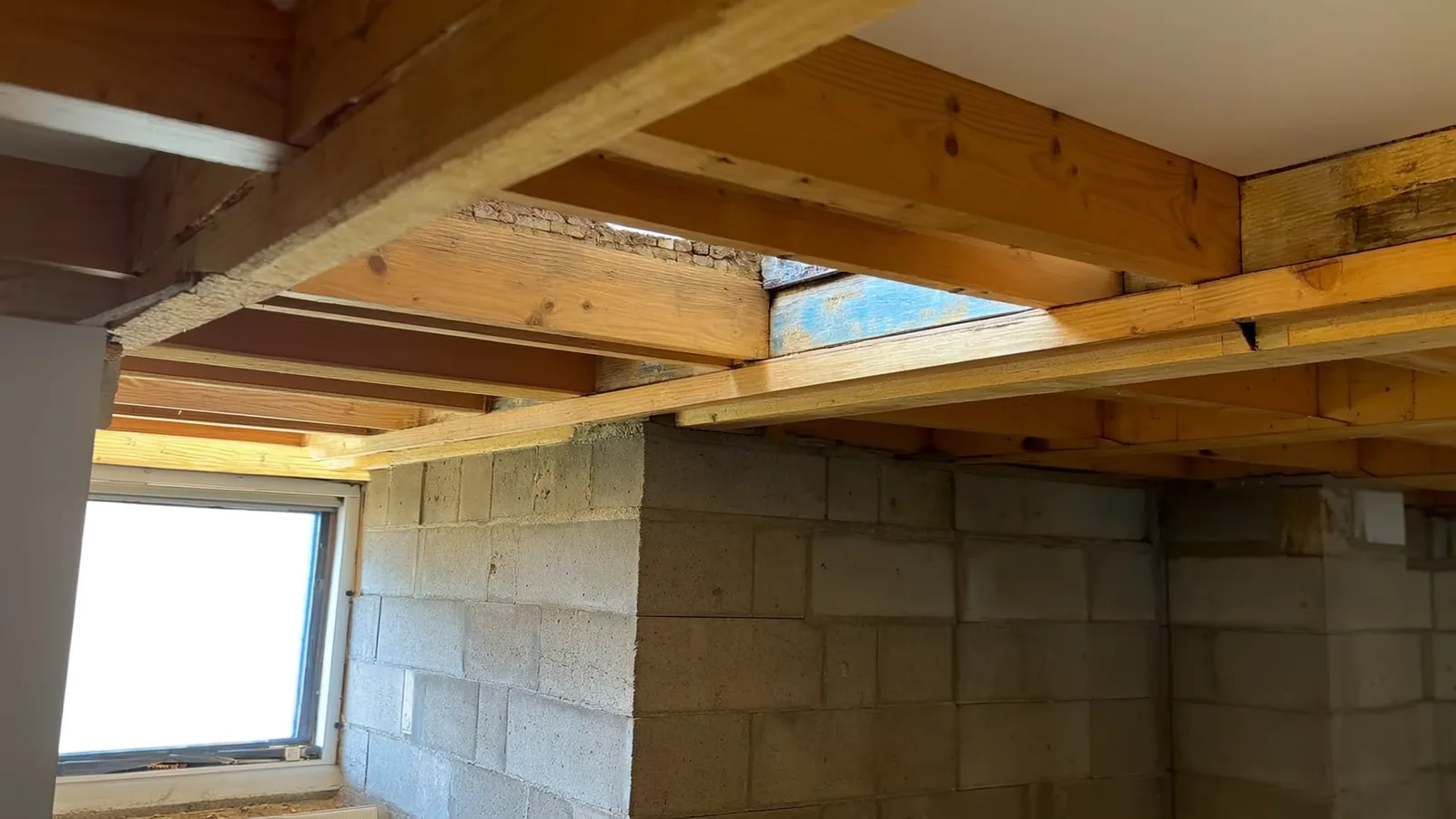
What is pier and beam repair and when is it the right choice?
Pier and beam repair is the process of restoring or supplementing the wood or concrete post-and-beam substructure that holds up the floor system in homes built over a crawl space. In the Knoxville metro, that covers the majority of residential housing stock built before 2000. Knox County’s hilly Valley-and-Ridge terrain made crawl-space construction the practical standard for decades, because pouring a flat slab on a sloped lot costs far more than setting piers and framing a floor above grade. When those piers settle, rotate, or rot, the floors above deflect, doors jam, and drywall cracks appear near load-bearing walls. Repair returns the bearing points to their designed position and replaces any failed wood members, stabilizing the floor system without excavating the perimeter.
If you are noticing those symptoms in your home, request a foundation inspection and repair estimate before the deflection progresses and secondary framing damage compounds the cost.
How pier and beam systems work mechanically
The system consists of concrete pads or wood blocks at grade level, vertical posts (wood or precast concrete), horizontal beams bearing on top of those posts, and floor joists spanning between beams. Load travels from the floor down through joists, beams, posts, and pads into the soil. When any link in that chain fails, whether from settlement of the pad, deterioration of the post, or moisture-driven rot in the beam, the floor above deflects. Repair either restores the failed link or adds a new, stronger one beside it.
Conditions where pier and beam repair is the right call
Pier and beam repair is appropriate when there is a definable bearing failure: a concrete pad that has sunk into soft soil, a wood post that has rotted from prolonged crawl space moisture, a beam that has sagged between supports, or a sill plate that has deteriorated at the foundation wall. It is also the correct intervention when differential settlement has caused one section of floor to drop relative to the rest. Knox County’s moderate-to-high shrink-swell clay in valley positions, combined with the 47.9 inches of annual rainfall recorded by NWS Morristown (KMRX), creates exactly the wet-dry soil cycling that destabilizes shallow pads over time.
Conditions where an alternative is better
If the crawl space has no structural settlement but shows high humidity, condensation, mold on joists, or early-stage wood softening without measurable deflection, crawl space encapsulation and vapor control is the more targeted solution. Encapsulation stops the moisture source before it causes pier failure. The two methods are frequently combined: repair the structure, then encapsulate to prevent recurrence.
Installation process
Pier and beam repair follows a consistent sequence, though the specifics depend on crawl space height, the number of failed piers, and whether the contractor encounters Knox County’s karst limestone close to the surface.
1. Pre-work inspection (2-4 hours)
The contractor enters the crawl space through the access hatch or a cut opening and walks the perimeter and field, probing posts, beams, and sill plates with a moisture meter and awl. They measure deflection with a string line or laser level. This inspection determines the scope: how many piers need replacement or supplementing, whether any beams need sistering, and whether the soil beneath failed pads shows signs of void or erosion.
2. Temporary shoring (1-2 hours)
Before any pier is removed or adjusted, temporary hydraulic jacks and cribbing are placed at adjacent bearing points to carry the load. This prevents further deflection during the repair and allows controlled lifting if re-leveling is part of the scope.
3. Pier repair or replacement (4-12 hours depending on count)
Failed wood posts are cut out and replaced with pressure-treated lumber or steel adjustable columns. Sunken concrete pads are either broken out and recast at greater depth, or supplemented with a helical pier driven to competent bedrock. On karst-affected lots common throughout Knox County, helical piers are frequently preferred because they bypass the shallow residual clay and anchor into the limestone below the solution cavity zone. Shims are driven or poured to bring the beam back to designed elevation.
4. Sill plate and joist repair (if required)
Rotted sill plates are sistered or replaced in sections. Sagged joists are sistered with new lumber fastened alongside the existing member. This work takes place in parallel with pier repair on larger jobs.
5. Load transfer and final leveling (1-2 hours)
Temporary shoring is released in a controlled sequence, transferring load back onto the repaired piers. The contractor re-checks deflection measurements and makes final shim adjustments.
6. Cleanup and documentation
Debris, rotted lumber, and old concrete fragments are removed from the crawl space. The contractor photographs completed work, notes pier locations on a sketch, and provides documentation for your permit file and future warranty claim.
Access requirements are real: the crawl space must have at least 18 inches of clearance for meaningful work, and a hatch large enough to pass lumber and equipment. Homes with less clearance may require cutting a new access opening through the floor or perimeter band.
Pier and beam repair vs. crawl space encapsulation
These two services address different stages of the same problem. Moisture is the original villain in most Knox County pier-and-beam failures. Seasonal rainfall soaks the soil, humidity rises inside unvented or poorly vented crawl spaces, wood absorbs moisture, and rot begins. Over years, that rot works upward from posts to beams. By the time floors are visibly sagging, the structural failure is already present.
Crawl space encapsulation installs a thick polyethylene vapor barrier across the crawl space floor and up the walls, seals penetrations, and typically adds a dehumidifier. It is highly effective at interrupting the moisture cycle before wood damage occurs, and it materially improves indoor air quality in the living space above. What it cannot do is correct a post that has already rotted or a pad that has already settled. Encapsulation on an unrepaired structure leaves the structural deficiency in place.
Pier and beam repair addresses the structural failure directly but does not change the moisture environment that caused it. A replaced post in an unencapsulated crawl space is exposed to the same conditions as its predecessor.
The honest recommendation for most Knoxville crawl-space homes showing both settlement and moisture: address the structural repair first, then encapsulate. Some contractors perform both in a single mobilization, which reduces total cost compared to two separate visits. Ask any contractor you interview which scope they are quoting and whether sequencing matters for your specific situation.
For a side-by-side breakdown of both approaches, see the comparison of pier and beam repair versus crawl space encapsulation.
Pier and beam repair cost in Knoxville, TN
Bob Vila’s foundation repair cost guide reports a per-pier cost of $1,000 to $3,000 for piering and underpinning work. This Old House corroborates the broader project range of $2,000 to $7,500 for foundation repair work. Total project cost for a Knoxville pier-and-beam job sits somewhere in that range for a typical single repair zone, and climbs when multiple piers, beam sistering, or sill plate replacement are involved.
Several local variables move the number in Knox County specifically.
Pier count and spacing. A single failed center post under the main beam costs far less than re-supporting six perimeter piers that have all settled on saturated clay. The inspection report should itemize each pier location.
Crawl space access and height. Tighter crawl spaces require more labor time per pier. Homes with less than 24 inches of clearance cost more to work in because crew members cannot move efficiently or use standard equipment.
Depth to competent bearing. In karst-affected Knox County lots, shallow soil may overlie solution cavities or highly variable residual clay. Reaching competent limestone bedrock for a helical pier can require driving 15 to 30 feet or more, which adds both material (pier extension segments) and time.
Wood rot scope. If the pier failure was caused by chronic moisture, beams and sill plates at the same location frequently need sistering or replacement. That work is billed separately from the pier itself.
Permit and engineering fees. A structural repair permit from Knox County or the City of Knoxville adds a flat fee plus any required engineer-stamped drawings. Budget a few hundred dollars for permits on straightforward jobs; engineering reports for complex karst-affected sites cost more.
For a detailed breakdown of how these variables apply to your specific address, see the pier and beam repair cost guide for Knoxville.
Warranty and transferability
A well-structured pier-and-beam repair warranty covers both materials and workmanship for the repaired bearing points, typically for 25 years, and transfers to a subsequent buyer if the home is sold during the warranty period. Transferability is not a minor detail: in a Knoxville resale market where buyers routinely order foundation inspections, a documented transferable warranty converts a repaired foundation from a negotiating liability into a documented asset.
Ask any contractor you interview the following questions before signing.
What exactly does the warranty cover? Materials only, labor only, or both? Does it cover re-leveling if a repaired pier settles again, or only replacement of failed materials?
What voids the warranty? Some warranties are voided by drainage changes, landscaping alterations, or failure to maintain the crawl space. Understand the exclusions before you commit.
Is the warranty underwritten by an independent third party, or is it backed solely by the contractor? A contractor-backed warranty is only as durable as the company itself. Third-party backed warranties survive a company closure.
How is the transfer processed at resale? Some warranties transfer automatically with the property record; others require a formal assignment and a transfer fee. Confirm the process in writing.
Permits and engineering in Knoxville
Tennessee adopts the International Residential Code (IRC) as its statewide building standard under TCA 68-120-101 and Rule 0780-2-2, as administered by the Tennessee Department of Commerce and Insurance. Structural repair work, including pier replacement and supplemental underpinning under a crawl-space home, generally falls within the definition of work requiring a building permit.
Permit jurisdiction in the Knoxville area depends on the address. Properties inside the City of Knoxville limits apply through the City’s One-Stop permits office. Properties in unincorporated Knox County apply through Knox County codes enforcement. Municipalities such as Farragut, Powell, and Halls have their own permit processes. Confirm jurisdiction before work begins, because pulling the wrong permit or skipping one entirely creates complications at resale when the buyer’s title search turns up unpermitted structural work.
Engineering involvement varies by scope. Straightforward replacement of like-for-like wood posts under an existing beam rarely requires a stamped drawing. Projects involving new helical pier installation, supplemental steel columns, or any load-redistribution work often require a licensed structural engineer to prepare or review the repair design. Knox County’s karst geology adds a layer: if a geotechnical concern about a subsurface void underlies the repair location, a contractor may recommend a geotechnical engineer’s assessment before finalizing the pier depth and type.
The permitting process protects you as the homeowner in two ways. First, it guarantees a third-party inspection of the structural work before the crawl space is closed up. Second, it creates a public record that the repair was performed to code, which matters when you sell the home or make a homeowners insurance claim. For more context on foundation repair services across the Knoxville metro, including how permit requirements vary by neighborhood and municipality, a local contractor familiar with Knox County jurisdictions is your most reliable guide.
If you are ready to move forward, schedule your free pier and beam inspection and receive a written, itemized estimate.