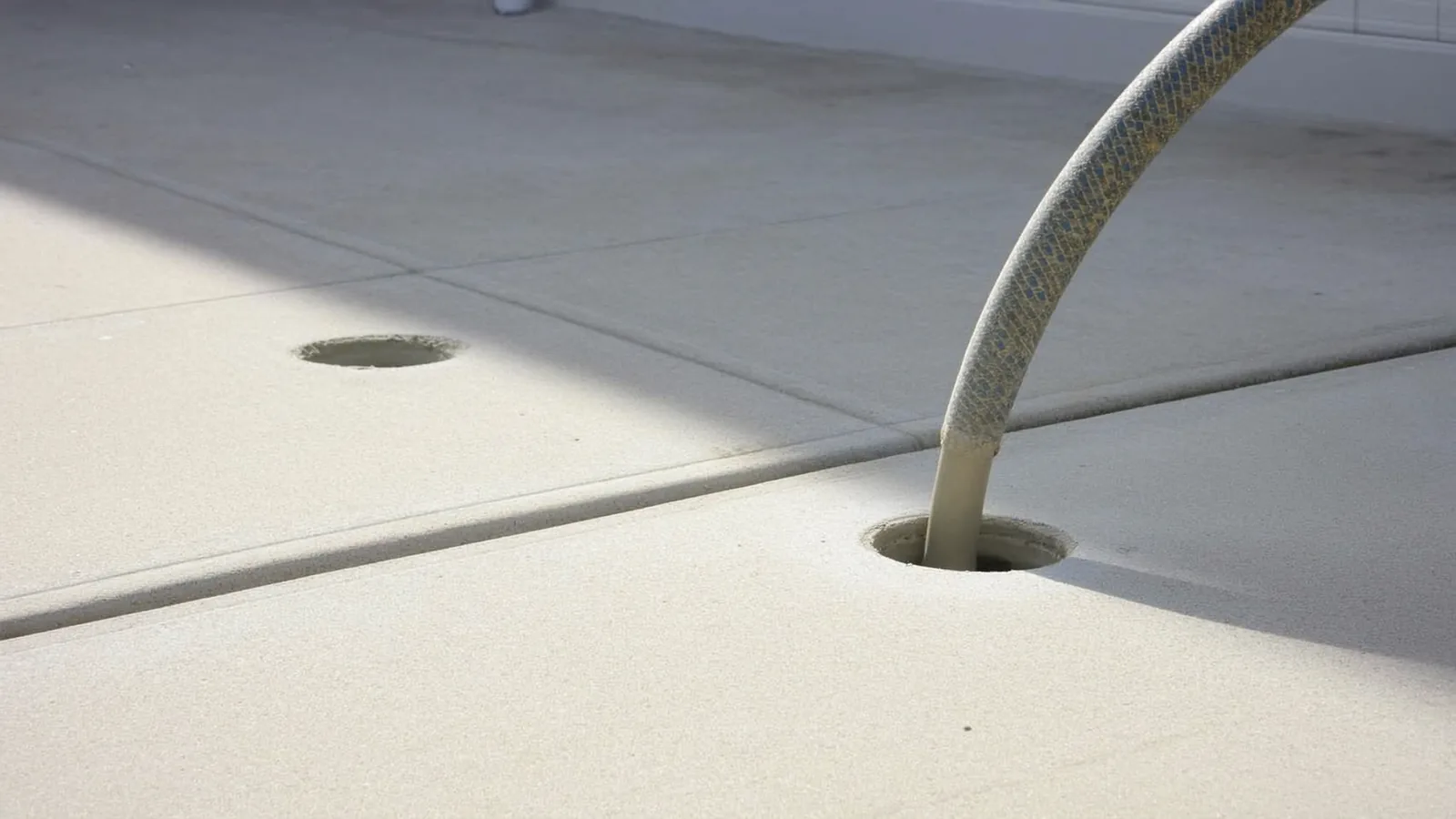
What is mudjacking and when is it the right choice?
Mudjacking is a slab-lifting technique in which a contractor drills a series of holes through a sunken concrete slab, pumps a cement-soil-water slurry beneath the surface under hydraulic pressure, and uses that slurry to fill voids and push the slab back up to its original grade. It is best suited to relatively shallow, isolated settlement, think a driveway that dips three inches near the garage apron, a sidewalk section heaved or dropped by soil movement, or a garage floor that pitched toward the interior wall. If those symptoms describe what you are looking at, mudjacking is worth a serious quote.
How it works mechanically
The slurry, typically a mix of Portland cement, sand, soil, and water, behaves as a fluid under the pressure of the pump but sets firm once injection stops. The contractor monitors lift in real time and stops pumping when the slab reaches target elevation. Excess slurry fills any voids beneath the slab as a bonus, which reduces the chance of future cracking from unsupported spans.
The conditions it is designed for
Mudjacking performs best when settlement is caused by void formation or slight soil consolidation beneath a slab that is otherwise structurally intact. Driveways, pool decks, sidewalks, steps, and garage floors are classic candidates. The slab must still be in reasonably good shape, significant cracking or spalling means lifting may cause further breakage. The soil beneath must be stable enough to support the added weight of the slurry without further compressing.
The conditions where an alternative is better
Mudjacking is not a deep foundation repair. If your settlement is caused by karst activity in Knox County, solution cavities collapsing beneath the slab, or a developing sinkhole, mudjacking will not address the root cause and may re-settle quickly. Similarly, if the settled surface is directly over known void networks or near drainage lines that have eroded the subbase, polyurethane foam leveling in Knoxville is lighter, cures faster, and introduces less additional load. For structural foundation problems involving footings, piers, or stem walls, get a free assessment and written estimate before committing to any surface leveling method.
Installation process
Mudjacking installation for a typical residential driveway section or garage floor runs as follows. Most jobs are completed in a single day, though cure time extends to the following day.
Step 1: Site inspection and layout (30-60 minutes)
The crew walks the settled slab, probes for soft spots, and marks the drill grid. Holes are typically spaced four to six feet apart in a pattern that gives even lift across the panel. The spacing changes near edges or corners to avoid overlifting one side.
Step 2: Drilling (1-2 hours depending on slab area)
A rotary hammer drill cuts 1.5 to 2 inch diameter holes through the concrete. Dust and debris are cleared from each hole. On a standard two-car garage floor, expect 12 to 20 holes total. The drilling is loud but requires no excavation. No landscaping is disturbed. Equipment stays on or beside the driveway.
Step 3: Slurry mixing and pumping (1-3 hours)
The pump truck mixes the slurry on site, drawing from bagged dry materials and water. The crew inserts a pump nozzle into each hole and injects slurry at controlled pressure, watching for slab movement at the surface. When one zone reaches target grade, the nozzle moves to the next hole. Crew members watch for slurry escaping at cracks or at the slab edge, a sign that the void is full.
Step 4: Hole patching and cleanup (30-60 minutes)
Each drill hole is packed with concrete patching compound and finished flush. The patches are visible as light-colored circles but are structurally sound. The crew removes equipment and cleans the work area. The slab should not receive foot traffic for 24 hours and vehicle traffic for 48 hours while the slurry cures.
Access requirements
The pump truck needs to park within roughly 50 feet of the work area with a clear path for the hose. For backyard patios or pool decks with tight gate clearances, confirm access width with the contractor before scheduling.
Mudjacking vs. polyurethane foam leveling
Both methods lift settled concrete slabs through injection, but they differ in material, cost, cure time, and the conditions where each performs best.
Mudjacking uses a dense, heavy slurry, which means significant added weight is pressed into the soil beneath the slab. That is not a problem on consolidated soil with good bearing capacity. On Knox County valley lots with moderately expansive clay, the added load can actually help stabilize the slab against further settling, because the slurry fills compressible voids with incompressible material. The lower cost per project makes mudjacking attractive when the area to be lifted is large: a full driveway, a long sidewalk run, or a wide garage floor.
Polyurethane foam leveling in Knoxville uses an expanding two-part resin. The foam is injected through smaller, 5/8-inch holes, expands to fill voids, and sets in about 15 minutes, a meaningful advantage when a driveway must return to service the same day. Because cured foam weighs only about two pounds per cubic foot versus roughly 100 pounds per cubic foot for hardened slurry, foam exerts almost no additional load on the soil. That makes it a better fit near areas with active moisture issues, near waterlines that could be stressed by added load, or on lots where karst activity makes a heavy fill inadvisable.
The honest edge case: if a Knox County lot has a documented history of sinkhole activity or if a soil report suggests shallow voids in the limestone, neither surface-injection method replaces a proper geotechnical evaluation. In that scenario, helical piers driven to competent bedrock are the standard recommendation, because both mudjacking and foam leveling rely on the soil to hold the lift.
Mudjacking cost in Knoxville, TN
Bob Vila’s foundation repair cost guide puts mudjacking at $500 to $1,300 for a typical project, with cost driven primarily by the number of square feet being lifted and the volume of slurry required. That range reflects national averages; Knoxville contractors generally fall within or slightly below it because material transport and labor costs in the East Tennessee market are lower than in major coastal metros.
Several local variables move the number up or down:
Depth of void. A slab that dropped two inches requires significantly less slurry than one that dropped five inches over an eroded subbase. Knox County’s karst geology occasionally creates deeper void pockets than the typical clay-shrinkage settlement seen in flatter markets, which can push material costs higher.
Slab area. Larger slabs require more holes, more slurry, and more crew time. A 400-square-foot garage floor costs more than a two-panel sidewalk section.
Site access. Pump trucks need to work close to the slab. A rear patio behind a narrow side gate may require additional hose runs, adding time and cost.
Slab condition. If the slab has significant cracks, the crew may recommend foam injection instead of slurry, because slurry escaping through cracks reduces lift efficiency and wastes material.
For a detailed breakdown of how these variables apply to your specific property, review the mudjacking cost guide for Knoxville or request a written estimate from a local contractor who can inspect the slab in person.
This Old House notes that foundation repair costs broadly average $4,500, reinforcing that mudjacking’s $500 to $1,300 range makes it one of the more affordable concrete repair methods available to Knoxville homeowners, when it is the appropriate solution.
Warranty and transferability
Mudjacking warranties in the residential market typically run two to five years on materials and workmanship. That is shorter than the 25-year transferable warranties common with helical pier or push pier underpinning, which reflects the reality that slurry-lift results depend heavily on soil behavior after the job.
When evaluating a contractor’s warranty, ask these specific questions:
What triggers a warranty claim? A good warranty covers re-settlement beyond a defined threshold (often one-half inch) within the warranty period. Vague language like “we will return if you are not satisfied” is not enforceable.
Does it cover materials and labor, or only materials? Return-trip labor costs add up quickly if the slab settles again. Confirm both are included.
Is it transferable? A transferable warranty adds value at resale. For a driveway or garage floor, this matters less than for structural repairs, but it is worth confirming.
What voids the warranty? Root intrusion, pipe leaks, and karst-driven subsidence are common exclusions. Ask for the list in writing. If a contractor refuses to put warranty terms in a signed document, treat that as a red flag.
In the Knoxville market, transferability matters more than the warranty length for most homeowners. Knox County’s Valley-and-Ridge position and active karst geology mean that soil conditions can change, so a five-year transferable warranty from a contractor with a strong local track record is more useful than a ten-year warranty from a company that may not service the area long-term.
Permits and engineering in Knoxville and Knox County
For most residential mudjacking projects, driveways, sidewalks, garage floors, patios, neither the City of Knoxville Development Services Department nor Knox County Building Inspection requires a building permit. Mudjacking lifts existing slabs without altering load-bearing elements, structural framing, or foundation footings, which puts it below the permit threshold in both jurisdictions under normal circumstances.
Two situations change that calculus. First, if the settled slab is part of a commercial structure or a building covered by a more stringent occupancy classification, check with Knox County Building Inspection directly. Second, Tennessee’s statewide building construction safety standards operate under TCA 68-120-101, administered by the Tennessee Department of Commerce and Insurance. If a project involves structural elements adjacent to the slab, or if an engineer of record is involved, permit requirements from the state code level may apply.
For residential homeowners on the Knoxville metro service area, the practical answer is: confirm with your contractor before work begins, because requirements can change and commercial-adjacent properties sometimes require documentation that purely residential projects do not. A reputable contractor will pull any required permits as part of the job scope, if a contractor suggests skipping permit confirmation entirely without checking, that is worth noting.
If the settlement is in an area with suspected karst activity, consider requesting a written soil assessment before the lift. Knox County’s limestone and dolomite parent material creates documented sinkhole risk across the county (USDA Web Soil Survey, Knox County; Tennessee Geological Survey karst mapping), and an engineering letter confirming stable bearing beneath the slab protects both the homeowner and the contractor if questions arise later.