What Vertical Cracks Look Like (and When to Act)
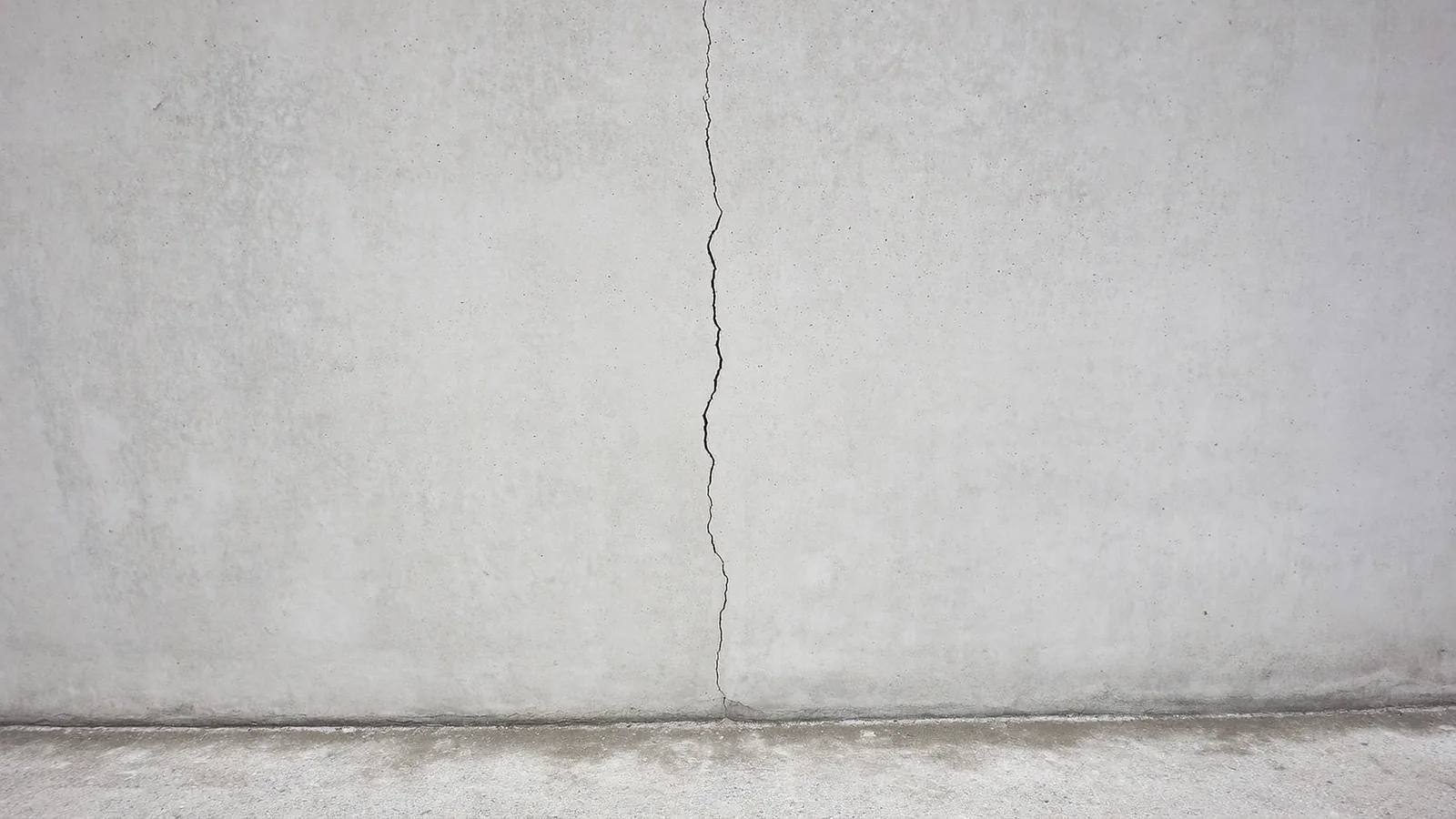
A vertical crack runs straight up and down on a foundation wall, sometimes with a slight diagonal lean of no more than 30 degrees. That orientation distinguishes it from horizontal cracks (which signal inward wall pressure) and stair-step cracks (which follow mortar joints in block or brick foundations). Vertical cracks are the most frequently spotted foundation symptom in Knoxville homes and the one most often misread in both directions. Homeowners either dismiss them as normal concrete aging or assume they signal imminent collapse. The truth sits between those two poles and depends on a handful of specific observations.
What It Looks Like Exactly
A harmless shrinkage crack is uniform in width from top to bottom, typically hairline-thin (under 1/16 inch), dry on both sides, and located near the center span of a wall. A crack that deserves professional attention is wider at one end than the other, shows a measurable offset where one side of the wall sits higher or lower than the other, measures 1/4 inch or wider at its broadest point, or shows water staining or active seepage. Multiple vertical cracks appearing in a pattern across a wall face, or a crack that has grown visibly since you first noticed it, are additional reasons to call for an inspection rather than wait.
Monitor vs. Act Now
A single hairline crack in a poured concrete wall with no offset, no water intrusion, and no change over six to twelve months is a “monitor” situation. Mark the ends of the crack with pencil and write the date beside each mark. Photograph it monthly. If width and length stay stable, you are likely looking at normal concrete curing shrinkage. Move to “act now” if: the crack reaches 1/4 inch wide anywhere along its length, if you can see light or feel airflow through it, if water enters during rain, or if the two sides of the crack are no longer flush with each other. In Knox County homes with crawl spaces, any vertical crack paired with sagging floors or a musty crawl space smell warrants an immediate inspection given how quickly crawl space moisture problems compound structural concerns.
What Not to Do
Do not fill a structural vertical crack with hydraulic cement, expanding foam, or exterior caulk before a professional identifies what caused it. Those materials are rigid and will re-crack if the wall continues to move. Applying a waterproofing paint over an active crack traps moisture and makes the crack harder to monitor. Removing soil from along the exterior to “take pressure off” the wall without understanding the drainage context can redirect water toward the footing rather than away from it.
What Causes Vertical Cracks in Knoxville, TN
Knox County sits in the Valley and Ridge province of East Tennessee, roughly halfway between the Great Smoky Mountains and the Cumberland Plateau (Wikipedia: Knoxville, Tennessee). That geography delivers two distinct foundation stressors that combine in ways not seen in most other Southeastern metros.
The first is shrink-swell clay. The primary soils across Knox County valley positions are residual clay and silty clay weathered from limestone, dolomite, and shale (USDA Web Soil Survey, Knox County, Tennessee). Those soils absorb water and expand, then release it and contract. With just under 47.9 inches of annual rainfall (NWS Morristown, KMRX, 1991-2020 Climate Normals) concentrated in wet springs followed by drier summers, Knox County foundations experience a constant push-pull cycle at the footing level. When one section of footing sits on wetter, swollen soil and an adjacent section sits on drier, contracted soil, differential settlement occurs. That uneven movement pulls the foundation in opposite directions and opens vertical cracks.
The second stressor is unique to this market: karst limestone bedrock. Knox County’s documented karst geology creates subsurface solution cavities and voids beneath the clay layer (Tennessee Geological Survey karst mapping). When a void migrates close enough to the surface, the soil above it can compact or subside suddenly rather than gradually. A foundation bearing over a developing solution cavity may show vertical cracking that progresses faster than ordinary shrinkage cracks and that does not stabilize on its own. This is the signature Knox County hazard. Homeowners in neighborhoods on the ridges and valley floors west of I-75, and in older East Knoxville and North Knoxville neighborhoods built before karst risk was well-mapped, face this layered exposure.
The Valley-and-Ridge terrain also concentrates stormwater at low points. Lots at the bottom of a slope receive subsurface drainage from uphill, keeping the soil beneath their foundations wetter and more swollen for longer. When that water eventually drains away during summer, the volume loss is greater than on flatter lots, producing a more dramatic shrink-swell differential.
Repair Methods That Address Vertical Cracks
The right repair depends on whether the crack is cosmetic (concrete curing only, no movement) or structural (reflecting active or historic settlement).
Epoxy crack injection is the appropriate method for a vertical crack in a stable, non-moving foundation wall. A technician ports the crack at intervals, seals the surface, and injects a low-viscosity structural epoxy that fills the crack from the inside out. The cured epoxy bonds to both sides of the crack and creates a joint that is often stronger than the surrounding concrete. This method addresses the crack itself but does not address settlement. If the crack opened because of soil movement that is now resolved (for example, a one-time drainage event that has since been corrected), epoxy injection is a complete repair. Learn more about how this process works on the epoxy crack injection service page.
Helical piers are the preferred underpinning method when vertical cracking reflects ongoing differential settlement, particularly in Knox County’s karst-affected areas. Helical piers are steel shafts with helical plates that are torqued into the soil past the shrink-swell zone and into competent bearing material, including bedrock. Because Knox County karst bedrock can be irregular, experienced installers monitor torque readings to confirm each pier has reached adequate resistance. Once installed, the pier brackets are connected to the foundation footing, lifting and stabilizing it. Read a full description of this approach on the helical pier service page.
Push piers (resistance piers) serve a similar stabilization purpose as helical piers but are driven hydraulically using the weight of the structure as reaction force. They are well-suited to heavier slab-on-grade foundations and to situations where the settlement zone is deep. In Knox County, push piers are used more often in flat-lot West Knox neighborhoods with slab foundations than in the hillier crawl-space neighborhoods of older Knoxville. The push pier service page covers installation details and what to expect during the process.
Crawl space repair is frequently part of a vertical crack repair plan in Knoxville because most pre-2000 homes in the area use crawl space construction. A deteriorating crawl space with high humidity, failing wood piers, or standing water adds load variation to the foundation walls above it. Correcting those conditions removes a contributing stressor. See the crawl space repair service page for the methods involved.
Typical Cost Range
Per Bob Vila’s foundation repair cost guide, crack repair runs $250 to $800 per crack. When settlement requires pier installation, the cost rises to $1,000 to $3,000 per pier, and total project costs can range from $4,000 to $12,000 for stabilization work. The overall national average for foundation repair sits at $5,001, with a typical range of $2,176 to $7,833.
In Knox County, projects that involve karst-related settlement tend toward the higher end of pier cost ranges because installers must drive to confirmed refusal rather than to a preset depth. Projects in older East or North Knoxville crawl space homes may also include concurrent crawl space work that adds to the total.
For a broader breakdown of what affects foundation repair pricing in this market, see the foundation repair cost guide.
Inspection Process
A free inspection for vertical cracks involves several specific steps that go beyond a visual walkthrough.
The inspector measures crack width at multiple points along its length to determine whether the crack tapers (wider at top or bottom) or is uniform. Tapering indicates differential settlement at one end of the wall. A tool called a crack comparator card confirms width to the nearest 1/32 inch. The inspector also checks for offset (whether the two sides of the crack are flush or one side protrudes) using a straightedge.
For Knoxville homes, the inspector checks the crawl space beneath the affected wall for soft or sunken piers, wood rot, moisture intrusion, and any indication that the substructure has shifted. Because vertical cracks near corners are sometimes the first visible sign of foundation rotation, the inspector measures floor elevations across multiple points using a digital level or water level to map the shape of any settlement.
In areas with known karst exposure, a qualified inspector notes whether the crack pattern is consistent with gradual clay shrinkage or with the more abrupt settlement signature of void-related subsidence. If void-related movement is suspected, the inspection may include a recommendation for a soil boring or geotechnical review.
The inspector also documents the crack with photographs dated at the time of inspection so that any future change can be compared objectively. This documentation matters if you are buying or selling a home, because a repair record with before-and-after photos converts a visible defect into a documented, addressed item. See the foundation problems resource hub for additional context on what inspectors evaluate.
When to Skip Repair (or Wait)
Not every vertical crack requires immediate intervention. A hairline crack in a poured concrete wall that is less than ten years old and shows no water intrusion, no displacement, and no growth over two monitoring cycles is almost certainly a normal curing shrinkage crack. Caulking it with a flexible sealant and noting the date is a reasonable response. Revisit it every six months.
Similarly, a crack that opened during an extreme weather event (heavy rain, a long drought, or the kind of soil saturation Knox County experienced during the remnants of Hurricane Helene in September 2024) and has not changed since conditions normalized may reflect a one-time soil movement event rather than an ongoing structural problem. A single inspection that rules out displacement and ongoing movement can give you confidence to monitor rather than spend on repairs.
Repair becomes urgent when cracks are active, widening, displacing, or letting water into the structure. In those situations, waiting compounds the problem and the cost.