What Horizontal Foundation Cracks Look Like (and When to Act)
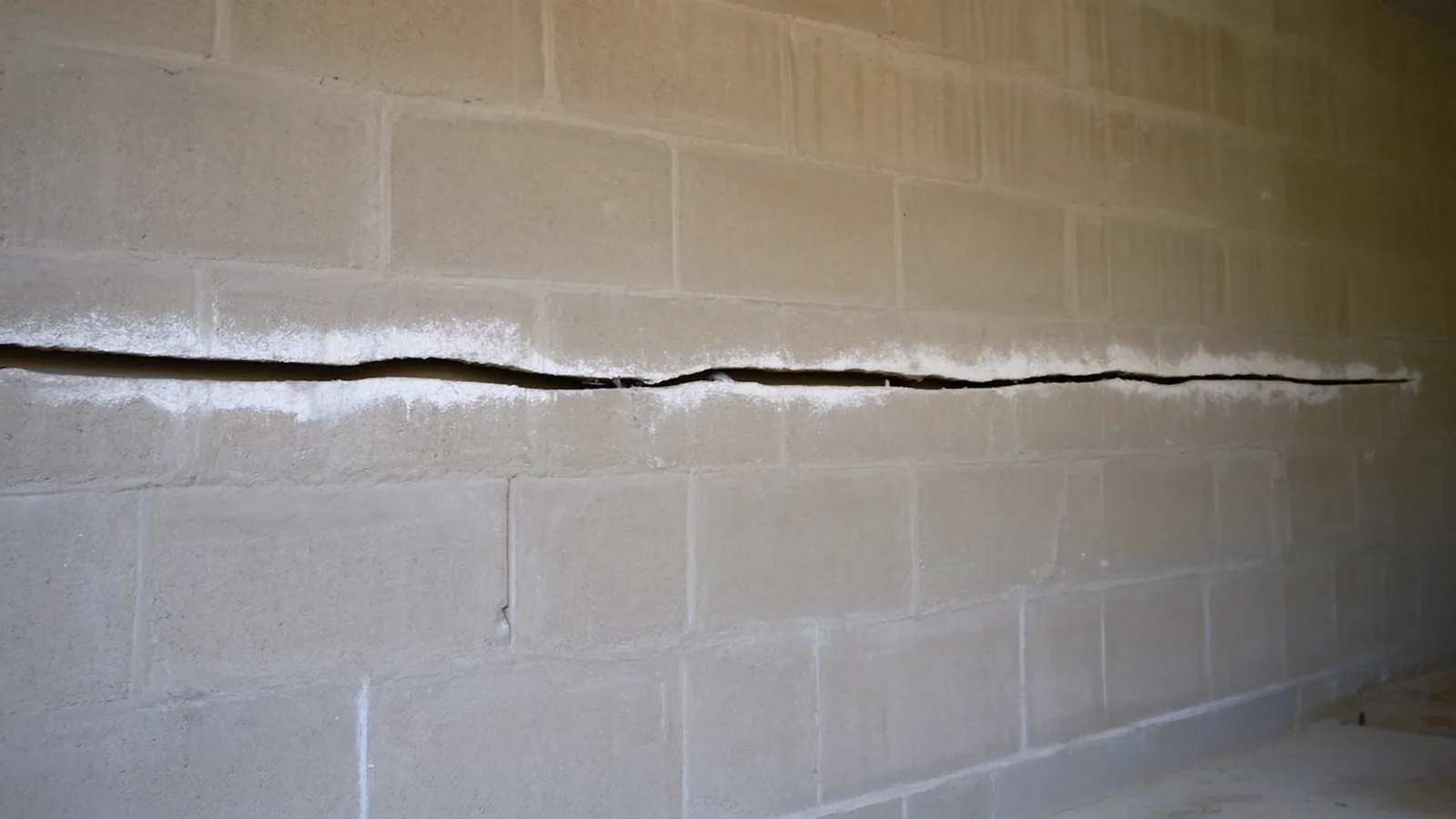
A horizontal crack runs perpendicular to the vertical axis of a foundation wall, typically appearing at or near mid-wall height where lateral pressure is greatest. You may see a single straight line crossing most of the wall’s width, a stair-step pattern along mortar joints in block walls, or a combination of both. In some cases the crack is accompanied by visible inward bowing, where the center of the wall curves toward the interior of the basement or crawl space.
What it looks like exactly
On poured concrete walls, horizontal cracks appear as relatively straight, continuous lines. On concrete block or cinder block walls, the crack often follows the horizontal mortar joints, giving it a layered appearance. The crack may be hairline-thin at first, or it may already be 1/4 inch or wider when discovered. Look also for white mineral deposits (efflorescence) along the crack line, which signals water is actively moving through the wall.
When to monitor vs. when to act now
If the crack is less than 1/8 inch wide, shows no inward deflection, and has been stable for years (confirmed by prior inspection records or pencil marks with dates), cautious monitoring every 30 days is reasonable for a short window. Any crack that is widening, any wall that is visibly bowing inward, or any crack wider than 1/4 inch falls into the act-now category. A wall that has deflected 2 inches or more inward is at elevated risk of partial collapse and requires emergency evaluation. Do not wait for a scheduled seasonal inspection.
What NOT to do
The most common mistake is patching the crack with hydraulic cement, epoxy injection, or waterproofing paint and assuming the problem is solved. Filling a horizontal crack without addressing the soil pressure behind the wall is the structural equivalent of taping a broken bone. The wall will continue to move, and the new material may mask the crack from view while the underlying failure progresses. Similarly, digging out the soil immediately behind a compromised wall without proper shoring can trigger sudden collapse. Leave excavation to professionals with the right equipment.
What Causes Horizontal Cracks in Knoxville, TN
Knox County sits in the Valley and Ridge physiographic province, and its geology creates a particularly demanding environment for below-grade walls. The primary soil is residual clay and silty clay weathered from limestone, dolomite, and shale (USDA Web Soil Survey, Knox County, Tennessee). These soils carry a moderate-to-high shrink-swell potential, meaning they absorb rainfall, expand against foundation walls, then contract during dry periods. With roughly 48 inches of annual rainfall (NWS Morristown KMRX, 1991-2020 Climate Normals), that expansion-contraction cycle repeats dozens of times per year.
When clay saturates fully, it presses outward against the wall with substantial hydrostatic and lateral earth pressure. The wall, acting as a horizontal beam between its footing and the floor above, bends under this load. The area of maximum stress, typically mid-wall, is where the horizontal crack first appears.
Knox County adds a second pressure source that sets it apart from most other Southeastern metros. The county sits on extensive karst limestone topography, with documented sinkhole activity and subsurface solution cavities throughout the area (Tennessee Geological Survey karst mapping). Karst voids can redirect groundwater in unexpected directions, concentrating drainage against one wall section rather than dispersing it evenly around the perimeter. This uneven pressure loading can produce a horizontal crack on a single wall while the other three walls appear unaffected, a pattern that sometimes confuses homeowners who expect damage to be uniform.
Heavy rainfall events compound the problem significantly. The remnants of Hurricane Helene in September 2024 saturated Knox County soils well beyond seasonal norms, causing rapid clay expansion that stressed walls that had been stable for years. Older homes in South Knoxville, East Knoxville, and the hilly neighborhoods of North Knoxville, many built before 1980 with thinner block walls, are especially vulnerable after saturation events because their original design predates modern lateral-load standards.
Valley-and-Ridge terrain also concentrates stormwater into valley positions. Homes on downhill lots in neighborhoods along Bull Run Creek, Beaver Creek, or the First Creek drainage corridor may experience persistent high soil moisture even in dry summers simply because uphill runoff channels toward their foundations.
Repair Methods That Address Horizontal Cracks
The right repair depends on how far the wall has moved, the wall material, and whether the underlying soil pressure can be relieved. The following methods are the primary options for Knoxville homes.
Carbon fiber straps are a common first-line stabilization method for walls with less than 2 inches of inward deflection. High-strength carbon fiber panels are bonded vertically to the interior wall surface, bridging the crack and preventing further movement. They do not push the wall back, but they stop it from moving farther. Because the work is done entirely from the interior, no excavation is required, which matters greatly on older Knoxville lots where mature trees or tight lot lines make exterior access difficult. Learn more about carbon fiber strap wall stabilization.
Steel I-beam wall bracing uses heavy steel beams set floor-to-ceiling against the compromised wall. The beams transfer lateral load to the floor slab at the base and to the first-floor framing at the top, taking pressure off the cracked wall section. Some beam systems allow incremental tightening over time, which can gradually return the wall toward its original position. This method handles more severe deflection than carbon fiber alone. Read about steel I-beam wall bracing.
Wall anchors involve driving steel rods through the wall into stable soil beyond the failure zone, then connecting them to interior wall plates. Periodic tightening of the anchor plates can exert slow inward-to-outward force, potentially straightening the wall over one to three seasons. This method requires adequate yard space for the anchor placements and works best when the soil beyond the failure zone is competent. See the wall anchor system method page.
Helical piers become relevant when horizontal cracking is accompanied by foundation settlement, which is more common in Knox County than in pure-clay markets because karst voids can cause the footing to lose bearing support simultaneously with wall failure. Driving helical piers to competent bedrock stabilizes the footing and prevents continued vertical movement while the wall is addressed separately. Given Knox County’s karst geology, helical piers are frequently the underpinning method of choice. Learn about helical pier underpinning.
Typical Cost Range
According to Bob Vila’s foundation repair cost guide, stabilization and reinforcement methods run $4,000 to $12,000. Carbon fiber strap installations fall toward the lower portion of that range for walls with modest deflection. Steel I-beam bracing and wall anchor systems with any excavation component push toward the upper end. Helical pier work runs $1,000 to $3,000 per pier when underpinning is also required, and multi-pier jobs are standard on longer wall sections.
For a full breakdown of what drives these numbers, see the Knoxville foundation repair cost guide.
What a Free Inspection Covers for Horizontal Cracks
A qualified foundation specialist evaluating a horizontal crack in Knoxville will do more than glance at the gap. Expect the following:
A plumb bob or laser measurement at mid-wall to quantify how far the wall has already deflected inward. A measurement under 1 inch is categorically different from one at 2 or 3 inches, and the number drives the method selection.
Crack-width measurement with a feeler gauge or crack comparator card, with the measurement recorded and dated so future visits can determine whether movement is active or dormant.
A check of the exterior grade and drainage patterns around the affected wall. Soil sloping toward the house, downspout discharge points near the wall, or evidence of ponding will be documented because those conditions must be corrected alongside any structural repair for the repair to hold.
In Knox County, a thorough inspector will also note any signs of karst influence: depressions in the yard, unusual drainage patterns, or previous sinkhole activity near the property. These observations may prompt a recommendation for geotechnical review before finalizing the repair plan.
For detailed information on what foundation inspectors examine across all foundation problem types, visit the foundation problems resource hub.
Schedule a free inspection to have a specialist measure your wall’s deflection and provide a written repair assessment with no pressure to sign.
When to Skip Repair or Wait
A small number of horizontal cracks warrant monitoring rather than immediate repair. If a hairline crack has been stable for five or more years, appears in a wall with no measurable inward deflection, and is located in a non-habitable area of a home where the wall carries minimal structural load, documenting its dimensions and watching it through a full seasonal cycle is a defensible short-term approach.
Monitoring is also appropriate when a homeowner has just purchased a property and needs 60 to 90 days to arrange financing. The condition of the wall at purchase should be documented photographically and with measurements so that any acceleration during the waiting period is immediately apparent.
Monitoring is not appropriate when the wall is already bowing, when the crack has widened visibly since it was first noticed, when water is actively entering through the crack, or when any deflection measurement is at or above 2 inches. Those conditions require professional intervention, not a wait-and-see approach.